Read Time: 11 min
In an era of rapid construction and metal fasteners, traditional timber framing stands as a testament to engineering that works with nature rather than against it. At the heart of this craft is mortise and tenon joinery—a method of connecting heavy timbers that has remained virtually unchanged for over a thousand years.
While many people associate this joint with fine furniture, its role in timber frame construction is far more demanding. In a building, these joints must manage immense structural loads, resist the “racking” forces of high winds, and accommodate the natural movement of wood across decades. In this guide, we will explore the mechanics of timber frame joinery, the specialized technique of draw-boring, and why this traditional method remains the gold standard for structural integrity.
TL;DR / Quick Summary
Mortise and tenon joinery is a traditional wood-joining method that uses interlocking “tongue and hole” connections secured by wooden pegs, providing superior structural strength and longevity compared to metal fasteners.
Key Takeaways:
- Mechanical Interlock: The joint relies on the geometry of the wood itself to transfer loads.
- Draw-Boring: A specialized technique using offset holes to pull joints tight without glue.
- Wooden Pegs (Trunnels): These allow the frame to move with the seasons without losing structural integrity.
- Generational Durability: Unlike metal bolts that can rust or loosen, timber joints often become tighter as the wood seasons.
What Is Mortise and Tenon Joinery?
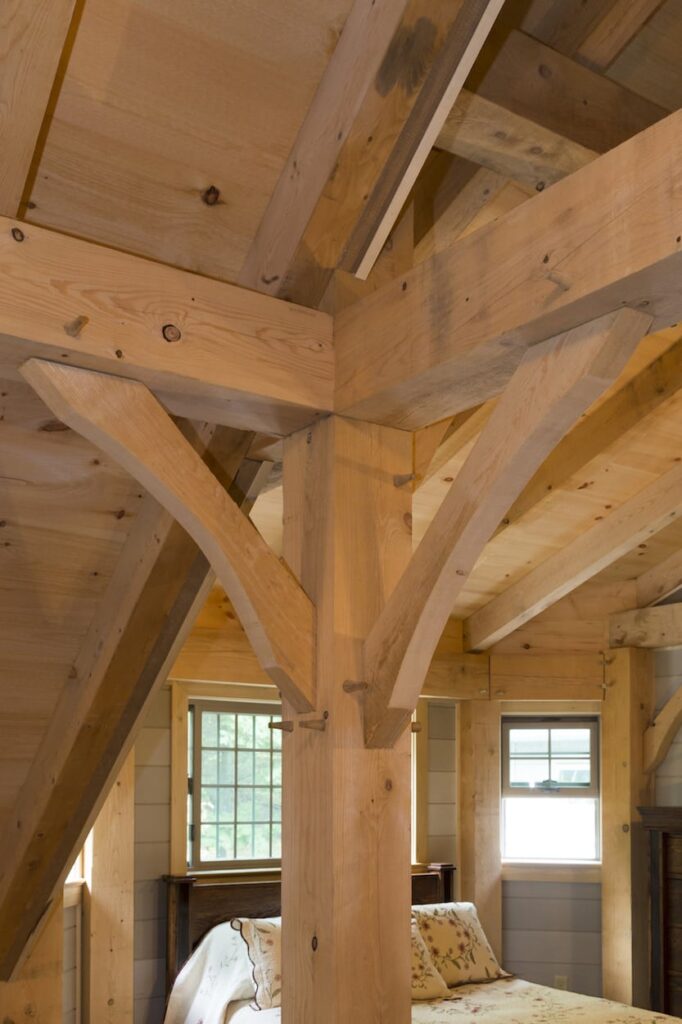
At its most basic level, a mortise and tenon joint consists of two parts: the mortise (a hole or pocket cut into one timber) and the tenon (a projecting “tongue” carved on the end of the joining timber).
In our timber frame construcitons, like timber frame barns and pavilions, these components are sized to handle massive weights. A typical tenon in a Crickside frame might be 2 inches thick and 5 inches deep, providing a massive surface area for load distribution. Once the tenon is seated within the mortise, it is secured with one or more wooden pegs, creating a connection that is structurally superior to nails or screws.
The Secret to a Tight Joint: Draw-Boring
One of the most common questions we receive is how a timber frame stays tight without the use of glue or metal brackets. The answer lies in a technique called draw-boring.
How Draw-Boring Works
- Offset Holes: We first drill a hole through the walls of the mortise.
- The Tenon Mark: We then insert the tenon and mark the center of that hole onto the wood.
- The Offset: When we pull the tenon back out, we drill the hole in the tenon approximately 1/8th of an inch closer to the shoulder of the joint.
- The Draw: When the joint is reassembled and the wooden peg is driven through, the offset holes force the peg to bend slightly. This creates a constant “draw” that pulls the tenon shoulder tight against the mortise face.
This mechanical tension ensures that even as the wood dries and shrinks over the first few years, the joint remains incredibly tight. This is a level of precision you simply won’t find in standard “post and beam” construction that relies on metal plates.
The Role of Wooden Pegs (Trunnels)
In traditional materials selection, the pegs—often called “trunnels” (tree-nails)—are just as important as the beams themselves. We typically use straight-grained, dried hardwood pegs for our frames.
Why Wood is Superior to Metal Fasteners
- Seasonal Movement: Wood expands and contracts with humidity. Metal bolts do not. Over time, a metal bolt can “crush” the wood fibers around it as the timber moves, leading to a loose connection. Wooden pegs move with the frame, maintaining a consistent bond.
- No Corrosion: Metal fasteners can rust, especially in the high-moisture environments of horse barn construction. Wooden pegs are immune to corrosion.
- Shear Strength: A 1-inch hardwood peg has immense shear strength, allowing it to hold thousands of pounds of lateral force without failing.
Types of Timber Frame Joints

While the mortise and tenon is the workhorse, a complete frame utilizes a variety of specialized joints:
- Scarf Joints: Used to join two shorter timbers end-to-end to create one long continuous beam.
- Bridle Joints: Often used at the peak of a rafter where two timbers meet at an angle.
- Lap Dovetails: Used where floor joists or purlins meet a main beam, providing “tension” that prevents the frame from spreading apart.
Conclusion
Mortise and tenon joinery is more than just a building technique; it is a philosophy of construction that respects the natural properties of wood. By utilizing the geometry of the joint and the tension of draw-boring, we create structures that are built to last for centuries. To learn more about our history and our commitment to this traditional craft, visit our about us page.
Serving Harrisburg, Carlisle, Chambersburg, State College, and the surrounding Central Pennsylvania region — with structures delivered throughout PA, MD, VA, and WV.
Contact Crickside Timber Craft today to discuss your custom timber frame project.
Frequently Asked Questions
Are mortise and tenon the strongest joints?
Yes, for structural timber framing, they are considered the gold standard. The combination of a large surface area for load transfer and the mechanical lock of the wooden peg makes them significantly stronger and more durable than modern metal-fastened joints.
What is the “Square Rule” in timber framing?
The Square Rule is a layout system where we cut joints based on a theoretical “perfect” timber inside the actual wood. This allows us to join irregular, natural timbers with extreme precision, ensuring every joint fits perfectly regardless of slight variations in the wood’s size.
Why don’t you use glue in your joints?
In large-scale timber framing, glue is unnecessary and often counterproductive. Because the wood needs to move seasonally, a rigid glue bond can actually cause the wood to crack (check) more severely. The mechanical tension of draw-boring provides all the strength needed.
How many pegs are used in a single joint?
This depends on the load the joint must carry. Most standard post-to-beam connections use two 1-inch pegs, while smaller braces may only require one.
Can timber frame joinery be repaired?
One of the greatest advantages of traditional joinery is that it is “reversible.” If a timber is damaged, the pegs can be bored out, the joint disassembled, and the timber replaced—something that is nearly impossible with modern nailed or glued construction.
Sources:
- Timber Framers Guild — Technical standards for traditional joinery and draw-boring.
- American Wood Council — Structural properties of heavy timber connections.